If Google had to describe your business today, would it get it right?
Not your logo.
Not your intentions.
Not what you meant to say.
What would Google say you actually do?
That question matters more than most businesses realize.
Because if search engines and AI platforms misunderstand your business, they may rank you for the wrong things, describe you too vaguely, or skip over you in favor of a competitor whose signals are simply clearer.
The Real Buzz
- Google does not know your business the way you do. It builds understanding from signals: your content, headings, navigation, internal links, schema markup, reviews, and consistency across your digital presence.
- If your signals are fuzzy, Google fills in the blanks. That can lead to vague search results, weak rankings, poor-fit traffic, or customers who arrive already confused about what you actually offer.
- Better SEO is not always about adding more keywords. Sometimes the bigger opportunity is making your existing message clearer, better structured, and easier for search engines to interpret.
- Schema markup helps Google label what matters. Structured data gives search engines cleaner context about your business, services, pages, FAQs, articles, and customer actions.
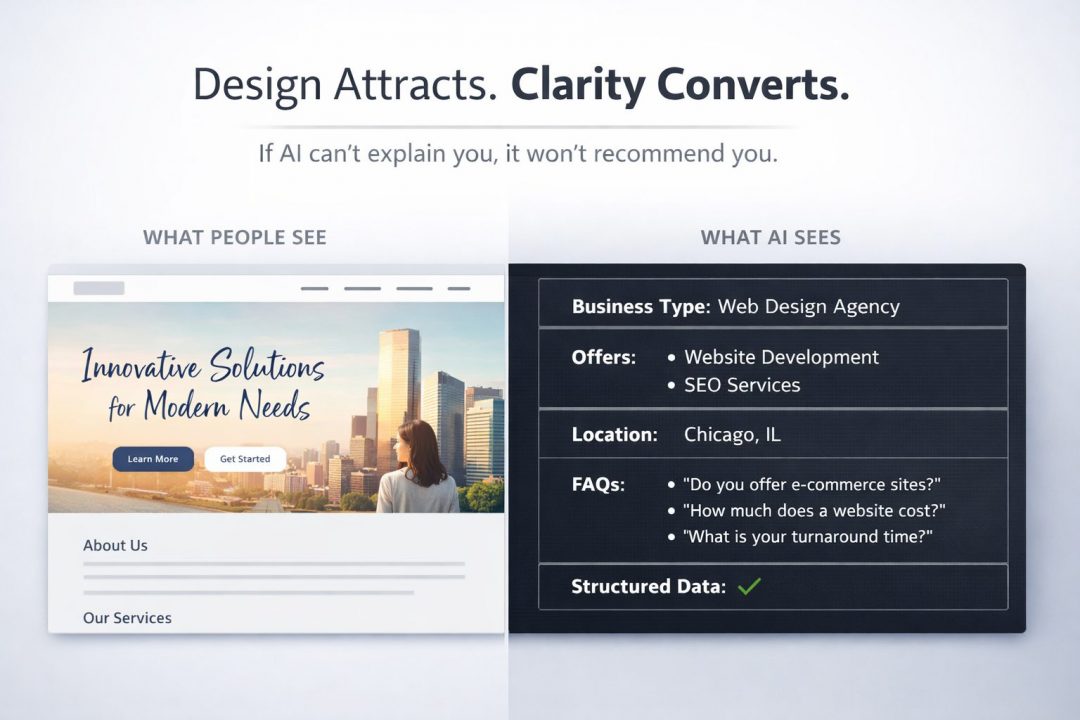
- AI search makes clarity even more important. Traditional search ranks pages. AI search interprets, summarizes, and recommends. If your meaning is unclear, AI tools may not represent your business accurately.

Why Google Gets Businesses Wrong
Most websites are technically present but strategically unclear.
They may show that a business exists. They may list a phone number, a few services, and a general description. They may even look polished.
But they often fail to clearly explain:
what the business specializes in
who it serves best
which services matter most
how those services connect
what makes the business different
what a customer should do next
That leaves search engines to simplify the business into something broader, vaguer, or less accurate than what the owner actually intended.
A hotel might get reduced to “lodging.”
A contractor might get reduced to “home services.”
A restaurant might get reduced to “food near me.”
A digital marketing consultant might get reduced to “website help.”
Those labels may not be wrong.
But they are not strong enough.
The goal is not for Google to know you exist.
The goal is for Google to understand why you are the right result.

What Actually Fixes the Problem
The solution is not stuffing more keywords onto a page.
It is making your meaning easier to understand.
That usually means improving three kinds of clarity.
Content Clarity
Your pages should clearly explain what you do, who you help, what problems you solve, and what outcomes your services support.
This does not mean writing robotic SEO copy.
It means being specific enough that both customers and search engines can understand the business without needing a follow-up conversation.
Structural Clarity
Your navigation, headings, page hierarchy, and internal links should reinforce how your services relate to each other.
A strong website should not feel like a pile of disconnected pages.
It should feel like a guided path.
Google follows that path.
So do customers.
Schema Clarity
Your structured data should support the story your page is already telling.
Schema markup helps search engines identify important information such as your business type, services, articles, FAQs, navigation, and customer actions. Google’s documentation explains that structured data helps Google understand page content and can make pages eligible for richer search features.
But schema should not be generic, outdated, or disconnected from the visible content.
It should reinforce the meaning of the page.
In other words, schema should make Google’s life easier.
And a happy Google is better equipped to bring you happy customers.
The Problem With Vague Website Messaging
Business owners often write website copy from the inside out.
They know what they mean.
They know their services.
They know their customers.
They know why their business is different.
But Google does not get the benefit of that background knowledge.
Neither does a first-time visitor.
That is where vague copy creates problems.
Phrases like “full-service solutions,” “quality service,” “customer-focused approach,” or “personalized support” may sound nice, but they do not always tell search engines much.
Google needs clearer signals.
What kind of service?
For what kind of customer?
In what situation?
With what outcome?
In what location or market?
Connected to which other services?
When those answers are missing, your website leaves too much room for interpretation.
And Google is not always great at reading between the lines.

Clarity Is a Technical SEO Issue
A lot of business owners think technical SEO only means page speed, mobile performance, crawlability, and code.
Those things matter.
But clarity is technical, too.
Your site structure tells Google which pages matter.
Your headings tell Google what each section covers.
Your internal links tell Google how your ideas connect.
Your schema markup labels the important parts.
Your metadata frames how the page should be understood before someone clicks.
Your content confirms whether the page actually delivers on that promise.
When those pieces work together, your site becomes easier to interpret.
When they do not, Google has to guess.
And guessing is not a strategy.
Why This Matters More in AI Search
Traditional search engines rank pages.
AI systems summarize, interpret, compare, and recommend.
That means your website now has to do more than contain the right words. It has to communicate your business clearly enough that machines can represent it accurately.
If your meaning is fuzzy, AI tools may:
oversimplify what you do
highlight the wrong strengths
miss important services
recommend a clearer competitor
send poor-fit traffic to your site
That makes clarity a visibility issue.
It is also a trust issue.
If AI search tools, Google snippets, or search results describe your business poorly, customers may form the wrong impression before they ever reach your website.

What Better Clarity Looks Like
When your content, structure, internal links, and schema all point in the same direction, Google has a much easier job.
Your business becomes easier to categorize.
Your services become easier to connect.
Your content becomes easier to interpret.
Your pages become easier to match with relevant searches.
Your next step becomes easier for customers to understand.
That is not a small technical detail.
That is a competitive advantage.
The businesses that win in search are not always the ones with the fanciest websites.
They are often the ones that are easiest to understand.
FAQs: How Google Interprets Your Business
Does Google really understand what my business does?
Not always. Google builds understanding from signals across your website and digital presence. If those signals are incomplete, vague, or inconsistent, Google may misunderstand or oversimplify what your business actually does.
Why would Google get my business wrong?
Google can get your business wrong when your content, headings, navigation, internal links, schema markup, reviews, or service descriptions do not clearly explain what you offer and who you serve.
Is this a keyword problem or a structure problem?
It can be both, but many visibility issues start as clarity problems. Keywords matter, but your website also needs strong structure, clear messaging, internal links, and schema that support the same story.
Can schema markup help Google understand my business?
Yes. Schema markup helps label important information about your business, services, pages, FAQs, articles, and customer actions. It gives Google cleaner context so it does not have to guess as much.
Why does this matter for AI search?
AI search tools summarize and interpret businesses based on available signals. If your website is unclear, AI systems may describe your business poorly, miss important services, or favor a competitor with clearer information.
Help Google — and Customers — Get the Right Message
If your website is not clearly communicating what you do, it may be limiting both your visibility and your conversions.
You do not need to trick Google.
You need to help Google understand.
KeyBuzz Digital helps businesses improve search clarity, strengthen schema markup, organize website content, and build connected digital strategies that make the right message easier for search engines, AI tools, and customers to understand.
Start with a Digital Presence Audit to see where Google may be guessing, where your message may be unclear, and where better structure could help your business become easier to find, understand, and choose.
Be Seen. Be Trusted. Be Chosen.

Stay Up to Date With The Latest News & Updates