
Stop Chasing Batting Averages and Start Winning Games
Why impressive advertising returns don’t always translate into business growth.
I’ve spent much of my career working in digital marketing, particularly in the hospitality industry. Over the years, I’ve reviewed countless marketing reports filled with charts, conversion rates, and impressive performance numbers.
And there’s one metric that continues to get more attention than I believe it deserves.
ROAS.
In fact, I’ll go a step further.
ROAS has become one of the biggest vanity metrics in digital marketing.
Now, before every paid advertising specialist starts reaching for the keyboard, hear me out.
I’m not saying ROAS is useless. I’m saying we’ve become so focused on celebrating a high ROAS that we’ve lost sight of what we’re actually trying to accomplish.
Growing a business.
First, What Exactly Is ROAS?
For those unfamiliar with the term, ROAS stands for Return on Ad Spend.
Think of it as digital advertising’s version of Return on Investment (ROI). In simple terms, how much did I spend, and what did I get in return?
Spend $1,000 on advertising and generate $10,000 in revenue attributed to those ads, and you’ve achieved a 10:1 ROAS.
For every dollar spent, the advertising platform reports ten dollars in revenue.
Sounds pretty good, right?
The trouble is that ROAS is often reported, interpreted, and presented in ways that don’t tell the whole story.
Unlike true ROI, which considers the financial return on an investment, ROAS compares advertising costs with the revenue attributed to those ads.
And there’s the catch.
Revenue attributed to advertising isn’t necessarily revenue generated because of advertising.
Just because an advertising platform takes credit for a sale doesn’t mean that advertisement was responsible for making it happen.
And even when the math is correct, the conclusions drawn from it can be misleading.
ROAS Is Like a Baseball Batting Average
Let me explain my frustration with an analogy from baseball.
Imagine two players.
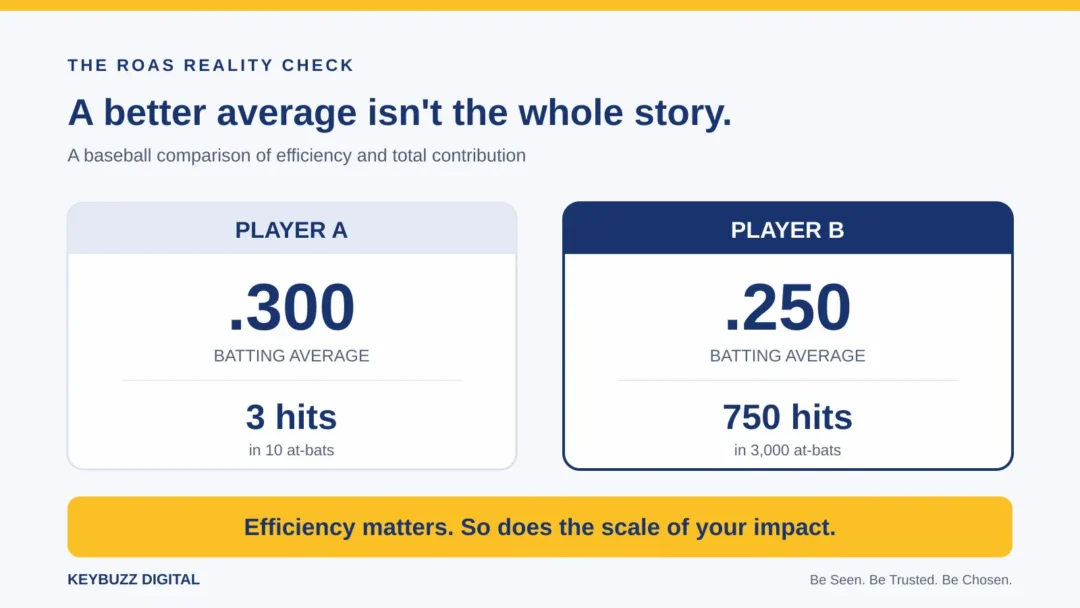
Player A has ten career at-bats and gets three hits.
That’s a .300 batting average.
Player B has 3,000 career at-bats and gets 750 hits.
That’s a .250 batting average.
Now, if we’re judging these players strictly by batting average, Player A wins.
But let’s ask a different question.
Which player contributed more to the team’s success?
Player A contributed three hits.
Player B contributed 750.
Of course, hits alone don’t tell us everything about a player’s impact. Runs, on-base percentage, and game situations all matter.
But would you really argue that the player with three career hits contributed more simply because their average was higher?
That’s the problem with relying on ROAS.
Let’s look at two hypothetical advertising campaigns.
| Metric | Campaign A | Campaign B |
|---|---|---|
| Advertising spend | $500 | $10,000 |
| Revenue attributed to ads | $5,000 | $50,000 |
| ROAS | 10:1 | 5:1 |
| Revenue above ad spend | $4,500 | $40,000 |
Campaign A has the better ROAS.
Twice as good, in fact.
But Campaign B generated ten times the attributed revenue and $40,000 above its advertising costs, before accounting for other business expenses.
Which campaign had the greater impact?
We can’t answer that from these numbers alone. We still need to understand profit margins, customer acquisition costs, and how much of that revenue was truly generated by advertising.
But that’s precisely my point.
A higher ROAS doesn’t automatically mean a more successful campaign.
Yet I’ve seen marketing performance discussions where improving ROAS becomes the goal rather than improving the business.
Imagine a baseball manager who only cared about batting averages and ignored how many runs the team scored.
That wouldn’t be much of a winning strategy.
And neither is managing your marketing that way.

Here’s the Bigger Problem: ROAS Doesn’t Reflect How People Actually Search
My biggest issue with ROAS isn’t even the math.
It’s the way advertising platforms assign credit for conversions.
Think about how people actually make purchasing decisions.
When was the last time you saw an advertisement for something you’d never heard of, clicked it, and immediately made a significant purchase?
Sure, it happens.
But when you’re making a major decision, like buying a house, replacing your roof, or hiring a contractor, you probably aren’t making that decision after one click.
You’re researching your options.
You’re comparing companies.
You’re reading reviews.
You’re asking friends and family for recommendations.
And somewhere along the way, you’re becoming familiar with businesses you may have never known existed.
Let’s Say You Need a New Roof
Imagine you’re a homeowner who notices a leak after a heavy rainstorm.
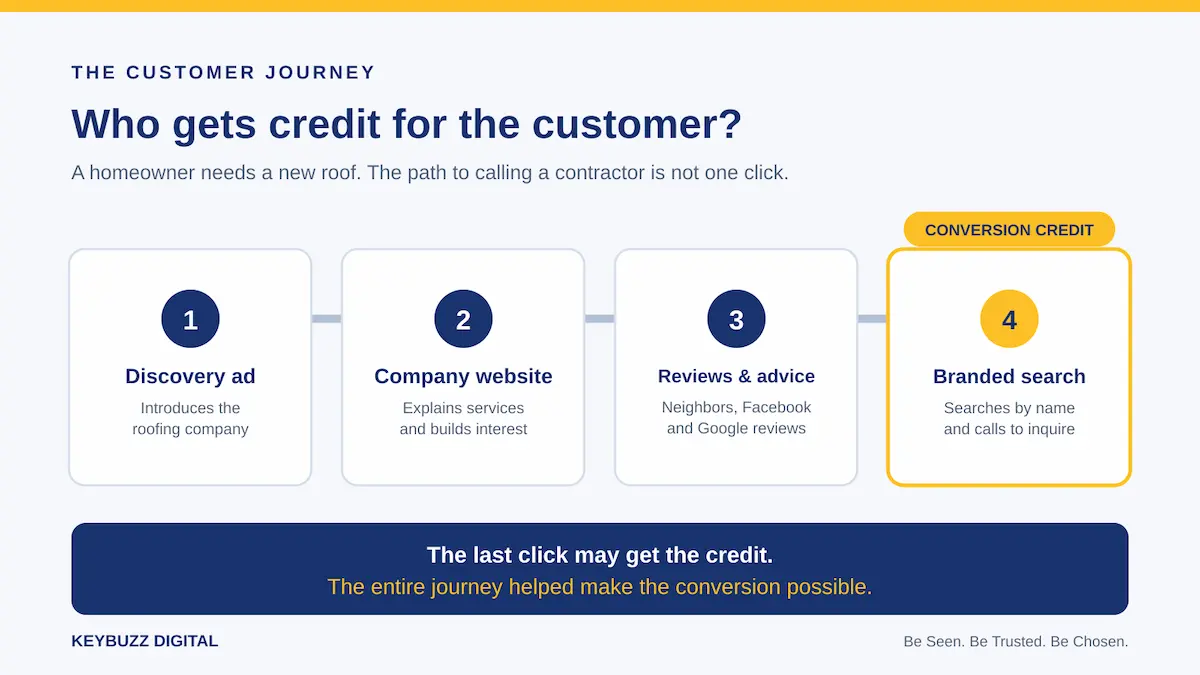
You search Google for “roof replacement near me.”
An advertisement introduces you to a local roofing company you’ve never heard of.
You click the ad.
You visit their website, browse their services, look at examples of their work, and learn a little about the company.
But you don’t request an estimate.
Not yet.
After all, replacing a roof is a major investment. You want to do your homework.
Over the next several days, you research roofing materials, compare costs, and read reviews.
You ask friends and neighbors about their experiences.
You post a question in a local Facebook group to see who others recommend.
You might even spend an evening watching YouTube videos to figure out whether replacing the roof is something you could tackle yourself.
(Spoiler alert: It’s probably a bigger project than you think.)
Eventually, you decide it’s time to call a professional.
You remember one of the roofing companies you came across during your research—the one you originally discovered through that Google advertisement.
Now that you’re ready to request an estimate, you search for the company by name.
And what appears at the top of the search results?
Another advertisement for that same company.
You click it, find the phone number, and give them a call.
Congratulations! The advertising platform records a conversion, assuming the call is properly tracked.
But here’s where things get interesting.
Depending on the attribution model and how the interactions were tracked, that final click on the branded advertisement may receive most or all of the credit for the lead.
Think about that.
The homeowner already knew the company’s name. They were specifically searching for that business because they were ready to contact it.
But the branded advertisement may get the credit.
Meanwhile, the original advertisement—the one that introduced the homeowner to the company in the first place—may receive little or no recognition.
It’s Like Giving the Closer All the Credit for Winning the Game
Let’s return to baseball for a moment.
Imagine your starting pitcher throws 8⅔ innings of a fantastic game.
He keeps the opposing team in check, works through a tough lineup, and gives his team every opportunity to win.
But when he leaves, the game is tied.
The relief pitcher comes in and records the final out.
His team scores in the next half-inning, and he gets credited with the win.
One pitcher did the heavy lifting for nearly nine innings.
The other faced one batter and got the official win.
Now, the rules of baseball determine who gets that win. The statistic isn’t wrong.
But does it tell you which pitcher contributed the most to the team’s success?
Of course not.
And that’s exactly what can happen with advertising attribution.
The final advertisement gets the credit because of how the reporting system assigns conversions.
But that doesn’t mean it did the most work to earn the customer.
The earlier advertisement introduced the business.
The website provided information.
Reviews and recommendations helped build trust.
And when the customer was finally ready to act, the branded advertisement was there to capture the conversion.
Each interaction had a role.
But if we judge performance only by which campaign received credit for the final conversion, we’re missing most of the game.
The closer may get the win, but that doesn’t mean the starter didn’t make it possible.
We’ve Confused Capturing Demand With Creating Demand
One of the most important distinctions in marketing is the difference between creating demand and capturing demand.
Creating demand means introducing your business to people who may not know you exist.
Capturing demand means reaching people who are already familiar with your business or actively looking for what you offer.
Both are important.
But they aren’t the same thing.
Let’s talk about branded search campaigns.
These are advertisements targeting searches that include a business’s name.
They can generate impressive ROAS because they’re often reaching people who already know what they want.
Those customers may already have decided which company they want to contact or where they want to make a purchase.
The advertisement helps them complete the process.
But here’s the question I wish more business owners would ask.
How did those customers know to search for your business in the first place?
Did they discover you through an earlier paid advertisement?
Did they find you through organic search?
Did they see your business mentioned in an article?
Did they discover you on social media?
Did they read your reviews or see your Google Business Profile?
Or was it a combination of several things?
In many cases, the answer isn’t a single marketing channel.
It’s the combined effect of multiple interactions over time.
And this is exactly why we talk about omnichannel marketing.
If you’re evaluating all those channels separately, without understanding how they work together, you’re making decisions based on an incomplete picture.
Now, don’t misunderstand me.
I’m not suggesting branded advertising is worthless.
There are legitimate reasons to use it, including maintaining visibility against competitors and helping customers reach your business.
But capturing demand doesn’t automatically mean you created that demand.
And if we don’t understand the difference, we risk making poor marketing decisions.
A metric can tell you that something isn’t working. It can’t always tell you what’s broken.
A Higher ROAS Can Actually Hide a Growth Problem
Let’s take that concept one step further.
Imagine a business running two campaigns.
The first targets people searching for the company’s name.
The second reaches people researching products or services who may have never heard of the business.
The branded campaign generates a 15:1 ROAS.
The discovery campaign generates a 3:1 ROAS.
Someone reviews the report and sees an opportunity.
Why spend money on a campaign producing a 3:1 return when another generates 15:1?
So they reduce the discovery budget and put more money into branded advertising.
The following month, the overall ROAS improves.
The agency celebrates.
Management is happy.
Everyone congratulates themselves on a successful optimization.
But what might actually be happening?
Fewer new customers are discovering the business.
More of the advertising budget is being directed toward people who already know the company exists.
And while the reported ROAS looks better today, the business may be weakening its ability to attract new customers tomorrow.
That’s not guaranteed to happen. Some discovery campaigns truly are inefficient, and some branded campaigns generate valuable additional business.
But ROAS alone can’t tell us which is true.
You can’t keep harvesting demand if you stop planting the seeds that create it.
That’s why chasing the highest ROAS can become a barrier to growth.
Sometimes the Marketing Isn’t the Problem
Here’s another issue with evaluating marketing performance strictly through advertising metrics.
Sometimes the advertising does exactly what it’s supposed to do.
It reaches the right person.
It introduces your business.
It captures their interest.
It gets them to visit your website.
And then something happens.
Let’s return to our roofing company.
Imagine the homeowner clicks the advertisement and likes what they see.
The company offers the services they need, works in their area, and has a professional-looking website.
So far, so good.
But before requesting an estimate, the homeowner decides to check the company’s Google reviews.
And that’s where things take a turn.
The company has a 2.8-star rating.
Several customers complain about missed appointments, poor communication, and unfinished work.
Suddenly, that homeowner isn’t so interested anymore.
They leave and contact another roofing company.
The advertising report records a click, some spending, and no conversion.
The campaign looks like it’s underperforming.
So what happens next?
Someone suggests changing the keywords, adjusting the bids, rewriting the ad copy, or cutting the campaign.
But wait a minute.
Did the advertisement actually fail?
It reached someone who needed a new roof.
It introduced that person to the business.
It generated enough interest for them to visit the website and consider the company.
The advertisement did its job.
The company’s reputation may have cost it the opportunity.
That’s not necessarily an advertising problem.
It may be an operational problem.
The Goal Isn’t to Point Fingers
Now, I’m not suggesting we start blaming sales, operations, customer service, or anyone else when marketing results fall short.
And I’m certainly not suggesting marketing should get a free pass when campaigns aren’t performing.
That’s not the point.
The point is that if we want to make the best business decisions, we need to understand all the factors influencing our results.
Not just the numbers appearing in an advertising report.
Maybe the advertisement is reaching the wrong audience.
Maybe the website is confusing.
Maybe customers are concerned about negative reviews.
Maybe pricing isn’t competitive.
Or maybe the business is generating plenty of qualified leads, but nobody is returning their calls.
Those are very different problems.
And they require very different solutions.
A metric can tell you that something isn’t working. It can’t always tell you what’s broken.
That’s why looking at marketing channels and business operations in isolation can lead to poor decisions.
The goal isn’t to find someone to blame.
It’s to understand what’s working, identify what’s getting in the way, and make informed decisions that help the business grow.
Let Your Website Reflect What Customers Value
Your reviews, responses, and website should tell a coherent story.
If customers repeatedly praise your communication, explain how you keep them informed. If they appreciate your local knowledge, demonstrate it through useful recommendations. If they value your ability to simplify a complicated process, show the steps involved.
For example:
-
An inn can explain the arrival process guests describe as welcoming.
-
A florist can answer the planning questions customers say were handled thoughtfully.
-
A service provider can show what happens between the first inquiry and the completed project.
Use customer feedback to identify what deserves more explanation on your service pages, FAQs, and testimonials.
Also check that your responses accurately reflect what you currently offer. An old reply describing a discontinued service can create confusion just as easily as an outdated webpage.
The goal is to help prospective customers recognize how your strengths relate to their needs.
This Is What Omnichannel Marketing Really Means
When I talk about omnichannel marketing, I’m not simply suggesting that businesses advertise on Google, post on Facebook, maintain a website, and manage their Google Business Profile.
That’s being present on multiple channels.
Omnichannel marketing means recognizing that those channels are connected and that customers move between them throughout their buying journey.
Your advertisement might introduce someone to your business.
Your website helps them understand what you offer.
Your reviews help them decide whether they trust you.
Your social media presence may reinforce that confidence.
And your responsiveness, customer service, and overall reputation can determine whether they ultimately choose you.
Every interaction can strengthen or weaken a customer’s confidence.
When we evaluate these channels separately, we miss how they influence one another.
And that’s when businesses start making poor decisions.
A campaign isn’t generating enough leads?
Maybe the keywords are wrong.
But maybe the website doesn’t answer the questions customers are asking.
Maybe the contact form doesn’t work.
Maybe the reviews are discouraging.
Or maybe nobody answers the phone.
You won’t find all those answers in a ROAS report.
Marketing metrics should help us ask better questions, not rush us toward the wrong answers.
That’s the value of looking at your entire marketing strategy rather than individual campaigns.
And Let’s Not Forget About Profitability
Even if we set aside every concern about attribution, ROAS still has another major limitation.
It measures attributed revenue, not profit.
Let’s say a business spends $2,000 on advertising and generates $10,000 in attributed sales.
That’s a 5:1 ROAS.
But what did it cost to deliver those products or services?
A retailer has inventory costs, shipping, packaging, and transaction fees.
A hotel has labor, housekeeping, amenities, and operating expenses.
A restaurant has food costs, labor, and overhead.
A service provider has the cost of delivering the work.
And what about advertising management fees, commissions, or discounts?
None of those are included in the basic ROAS calculation.
Depending on the business, a 5:1 ROAS could represent a healthy return or a disappointing result.
So even if every conversion was attributed perfectly, ROAS still wouldn’t tell you whether the advertising was profitable.
It’s one piece of the equation.
Not the answer.
So, What Should Businesses Measure Instead?
I’m not suggesting we eliminate ROAS from advertising reports.
It has value.
It can help identify changes in campaign performance, compare similar campaigns, and provide a useful measure of attributed advertising efficiency.
But we need to stop treating it as the ultimate measure of marketing success.
Instead, I encourage business owners to ask a few broader questions.
Are We Attracting New Customers?
Are your marketing efforts introducing your business to people who weren’t previously aware of you?
New customer acquisition matters, especially for businesses looking to grow beyond their existing customer base.
Is Overall Business Revenue Growing?
Forget the advertising dashboard for a moment.
Are total sales increasing?
Are more customers contacting your business?
Are you generating more qualified leads?
Is your marketing helping create opportunities that weren’t there before?
Are We Growing Profitably?
Generating revenue is important.
Keeping enough of that revenue to operate and grow your business is even more important.
Understand what it costs to acquire a customer and what that customer contributes to your business.
Is Our Brand Becoming More Recognizable?
Are more people searching for your business by name?
Are direct website visits increasing?
Are more customers discovering you through organic search, referrals, reviews, and other channels?
These trends can help you understand whether awareness is growing, although they shouldn’t automatically be credited to one campaign.
Are Our Marketing Channels Working Together?
This is where I believe many businesses miss the bigger picture.
Paid advertising doesn’t operate in a vacuum.
Neither does SEO, social media, email marketing, or your Google Business Profile.
Each can play a role in helping customers discover, evaluate, and choose your business.
And when possible, businesses should use testing to understand incrementality—the additional customers, revenue, or profit generated because of advertising, beyond what would have happened anyway.
That’s a much more useful question than simply asking which advertisement received credit for the sale.
Marketing Is a Journey, Not a Single Click
Here’s what I wish more business owners understood about digital marketing.
Customers don’t think in marketing channels.
They don’t wake up and decide to move from the awareness stage of your paid search campaign into the consideration stage of your organic search strategy.
They simply look for businesses that can meet their needs.
They discover options.
They gather information.
They compare alternatives.
They build confidence.
And eventually, they make a decision.
Your job as a business owner isn’t to make sure one advertising platform receives credit for that decision.
It’s to make sure your business is visible, credible, and worth choosing throughout the process.
That’s why effective marketing needs to look beyond individual campaigns.
Your website matters.
Your search visibility matters.
Your advertising matters.
Your reviews and reputation matter.
Your social media presence matters.
And the experience customers have with your business matters.
Some of those interactions will show up in your advertising reports.
Others won’t.
That doesn’t make them any less valuable.
At KeyBuzz Digital, this philosophy is reflected in our promise:
Be Seen. Be Trusted. Be Chosen.
Because being chosen often starts long before the final click.
Stop Chasing the Batting Title. Start Winning Games.
Let’s return to baseball one last time.
A player can have a great batting average without making much of a contribution to the team’s overall success.
A pitcher can receive credit for a win without having done most of the work that made it possible.
The statistics aren’t necessarily wrong.
But they don’t tell the whole story.
And neither does ROAS.
ROAS can tell you how much revenue an advertising platform attributes to your spending.
It cannot, by itself, tell you how much new business you created.
It cannot tell you whether customers would have purchased without seeing your advertising.
It cannot tell you how much your other marketing channels contributed.
It cannot tell you whether something outside marketing is hurting your results.
And it certainly cannot tell you whether your business is more profitable.
So the next time someone proudly presents a marketing report celebrating a 10:1 ROAS, don’t be afraid to ask a few more questions.
How many of those customers were already searching for us?
How many discovered our business because of our marketing?
What happened along the way that influenced their decisions?
And most importantly, is our marketing helping our business grow profitably?
If your marketing team can’t answer every question precisely, that’s understandable. Marketing measurement isn’t perfect.
But they should be able to explain what the numbers do and don’t tell you—and help you understand whether your investment is moving your business forward.
Remember:
A metric can tell you that something isn’t working. It can’t always tell you what’s broken.
Because at the end of the day, you aren’t investing in marketing to produce a pretty report.
You’re investing to grow your business.
And just like baseball, the goal isn’t to have the prettiest batting average.
The goal is to win games.
Be Seen. Be Trusted. Be Chosen.
Frequently Asked Questions About ROAS
What is a good ROAS for digital advertising?
There isn’t one ROAS target that works for every business. A 3:1 return may be profitable for one company, while another needs a much higher return to cover its costs. Profit margins, customer value, advertising expenses, and business goals all matter.
Why do branded search campaigns often have a higher ROAS?
Branded search campaigns reach people already looking for a specific business. These customers may be further along in their buying journey and more likely to convert. However, their interest may have started with earlier advertising, organic search, recommendations, or other marketing channels.
Is ROAS the same as ROI?
No. ROAS compares revenue attributed to advertising with advertising spend. ROI evaluates financial return relative to investment costs and takes profitability into account. A campaign can report a high ROAS without generating a strong profit.


